
Florida Fugitive Lists
Florida does not run one master wanted list. The Florida Department of Law Enforcement (FDLE) offers a Public Access System (PAS) search. It covers people entered as wanted. The Florida Department of Corrections (FDC) keeps separate searches for absconders and for escapes from state custody. The U.S. Marshals Service (USMS) posts three Florida district pages with profiled fugitives and task-force details. County sheriff sites round things out with local lists where those exist.
The populations differ. An FDLE entry traces back to a reporting agency's wanted-person record. An FDC absconder involves state supervision, while an escape entry means someone left state custody. A USMS profile is a federal matter picked for that district's page. None of these equals a statewide warrant database.
Photos and short summaries leave a lot unsaid. Statuses shift as pages go unchanged. For the current standing of any record, ask the agency named in it. Then check the court file.
Florida Wanted List Systems
Match the system to the status you need. Names can overlap across databases. What separates them is the agency and the custody stage behind each entry. These tools stand apart, not as one combined database.
| Official list | Agency and scope | Photo information | Where to look |
|---|---|---|---|
| Wanted persons | FDLE Public Access System, records supplied through the Florida Crime Information Center (FCIC) | A camera icon appears when an image is present. | FDLE search |
| Absconders and escapes | FDC, separate state custody and supervision populations | Use the FDC profile; these are not county booking photos. | FDC search menu |
| Federal fugitives | USMS, selected profiles and task-force information by federal district | See the official profile page; this is not a complete photo or warrant index. | Northern, Middle, and Southern Districts |
The three USMS district pages cover different federal areas and show profiled cases only. FDLE and FDC update their databases on their own schedules. Check each system's own details and dates directly. Never assume one agency's page matches another's.
Florida County Wanted Pages
Sheriffs across Florida may post wanted pages of their own. Florida has no statewide index of county warrants. A county page is usually a curated notice. It is not a full record of every court's open process. Editors often focus on a handful of cases. Other entries involve people whose identity or location is in question. A blank page proves nothing about what the courts hold.
Work from the county where the arrest, case, or issuing agency belongs. When a sheriff's wanted page exists there, read the original entry. Note its date and contact route. When it doesn't, the court clerk or the agency on the record handles verification. The statewide County Directory routes to Florida's local sites. County-level sheriff and court sources are organized there.
Do not confuse a wanted list with a jail roster. A sought person may be free. A jail detainee may carry no wanted entry. A county booking photo differs from an FDC offender photo tied to prison custody or supervision. Always check the record type first.
Note: A county's empty wanted page does not show that its courts and agencies hold no open cases.
Report a Florida Fugitive Tip
Use the official route attached to the listing you saw. FDLE's wanted-person detail can include a tip button. The button sends your report to the entering agency. FDC's offender-search pages carry their own tip route for absconder and escape entries. USMS posts a 24-hour fugitive tip number. It appears on the Florida district pages. Florida guarantees no statewide reward program or anonymity, so assume neither.
- Open the agency's own wanted or fugitive entry and confirm the agency name and case details.
- For an FDLE entry, use the detail page's tip button so the information reaches its reporting agency.
- For an FDC absconder or escape entry, use the official tip route shown through FDC's search pages.
- For a federal profile, use the linked USMS district page. Its listed 24-hour tip number is 1-888-869-4589.
- Share only what you know with officials. If there is an immediate threat, call 911.
FDLE passes the tip to the reporting agency. The USMS number appears on the federal district pages. Neither route deputizes you. Share the source URL, or the name and case number shown, and let officials judge the claim.
Safety: Never approach, follow, confront, or try to detain anyone on a wanted page. Listings can be stale or wrong. Intervention puts people at risk.
Florida Wanted Lists and Warrants
A wanted list is really just a notice board. The warrant behind it is a court order tied to one case. No public list includes every warrant out there. FDLE cautions a listing proves neither point. A warrant may no longer be active, and the person may no longer be wanted. Data flows into FDLE through FCIC on a roughly 24-hour cycle. So a fresh court action or an agency correction can lag before it shows up.
No single public database covers every active Florida warrant. A name missing from FDLE or a sheriff's wanted page means nothing. For a specific case, go to the county Clerk of Court where it was filed. Then reach out to the agency that issued or reported it. Local search tools and record practices vary. Ask the clerk how to confirm current status.
- Use the available record to identify the county, court, issuing agency, and case or warrant number.
- Search the relevant county Clerk of Court criminal docket by name and case number when available.
- Contact the issuing agency to ask whether the order remains active and which court record controls.
- Verify unclear or conflicting information with the court or a lawyer before deciding what the record means.
Never try to serve a warrant or approach anyone on a list. A third-party post is not proof of current status either. For the official path to booking and case records, use the Florida statewide arrest-record search overview.
Florida Court Disposition Checks
The court file tells you what happened after an arrest or a warrant request. Florida has no single public statewide trial-court criminal search. The Florida Courts ACIS portal handles appellate and Supreme Court material only. It can't replace a county clerk's criminal docket. The secure Clerks CCIS system is built for official use rather than public case searches.
Search in the county where the case was filed. Avoid the county where the person was last seen. Most clerk portals let you query the criminal docket by name and case number. If a case won't come up, ask the clerk for the docket directly. Or ask about the office's public access route.
- Read the county and case number from the official wanted entry or related record.
- Open that county Clerk of Court's criminal-case search and look up the name or case number.
- Read the docket for the latest disposition or warrant-related entry, using the clerk's own terms.
- Ask the issuing agency to confirm whether a warrant is active; check with the court or a lawyer if entries conflict.
A trial-court docket and an appellate case search are different animals. Neither portal alone confirms every current warrant.
Note: A court entry can lag behind an agency update, so use the clerk and issuing agency to resolve any mismatch.
Search Florida FDLE Wanted Records
FDLE's Public Access System is the statewide entry point for wanted-person records fed through FCIC. Think of it as a search tool, not a full public warrant docket. The form has a rule. Enter at least the last two characters of a name, or an exact nickname. An exact nickname also works on its own. Date of birth, age, race, and sex can narrow things down. Those extra fields help a lot with common names. Any match still needs review against the reporting agency's own record.
| Search field | How it is used |
|---|---|
| Name or nickname | Enter at least the last two characters of a name, or an exact nickname. |
| Date of birth or age | Use the available age detail to narrow results. |
| Race and sex | Additional fields shown by the FDLE form to refine the search. |
A result can include name, date of birth, race, sex, and reporting agency, plus a camera icon when a photo exists. The detail page may add aliases, the offense, agency details, case and warrant numbers, dates, physical descriptors, and a tip button that routes to the reporting agency. The FDLE wanted-person search form appears below, showing its search fields rather than any person's face.
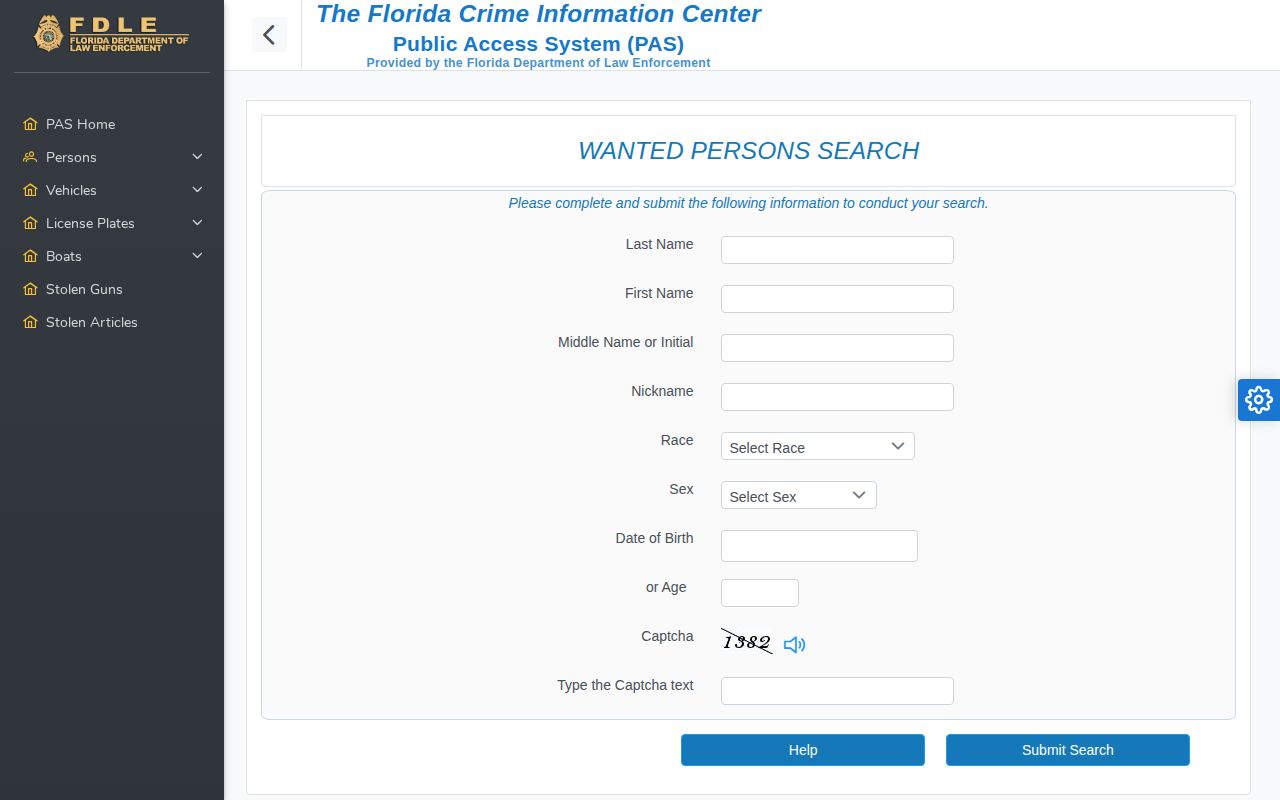
FDLE refreshes this wanted-person information from FCIC about every 24 hours. Even so, a listing does not confirm a warrant is still active. Nor does it confirm the person remains wanted. A photo icon has a simple meaning. It just shows an image attached to the record. Verify current status with the reporting agency and the court.
Florida FDC Absconders and Escapes
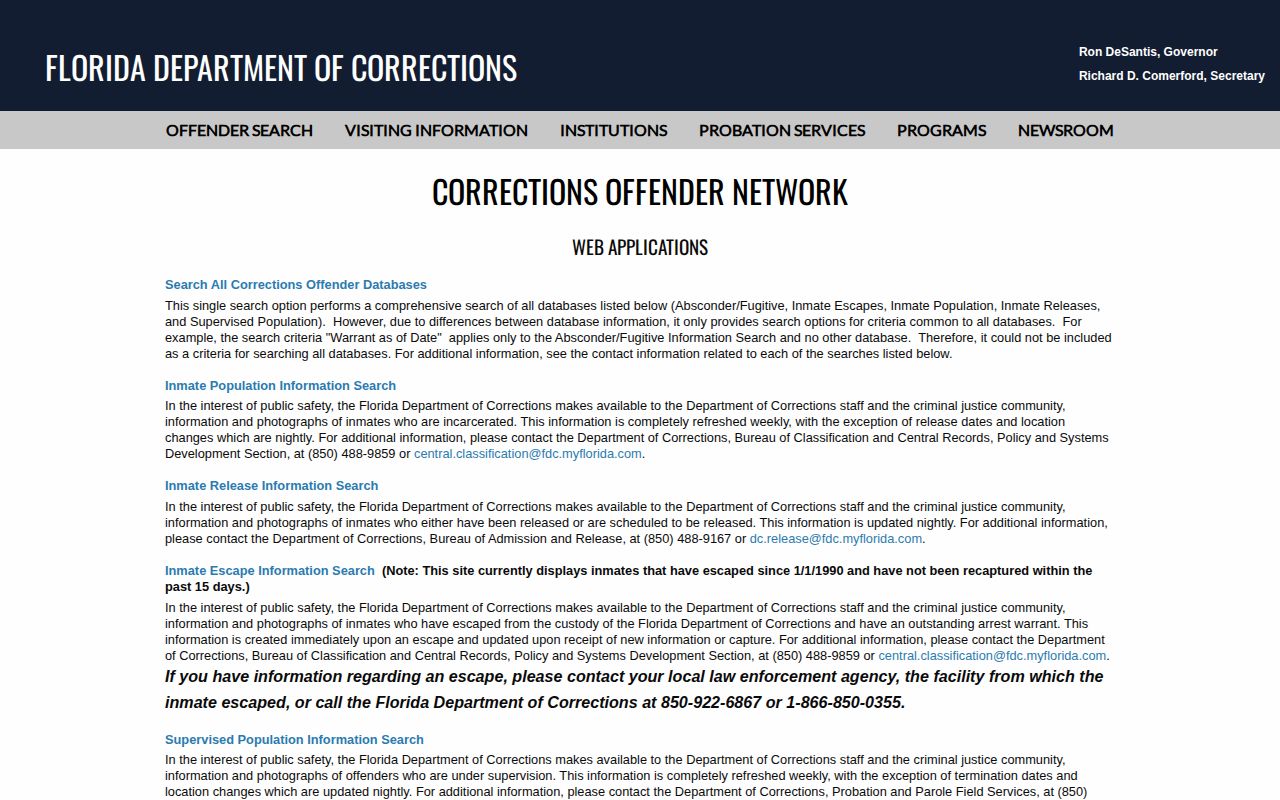
The Florida Department of Corrections keeps absconder and fugitive searches apart from escape searches. An absconder is someone tied to state supervision. An escape entry covers a person who left state custody. The two groups update on different rules. Neither belongs mixed with the FDLE wanted list or a county jail roster. The FDC search menu offers separate paths for inmates, releases, escapes, and absconders, as pictured below. Pick your population from the official menu. Do not treat every FDC result as a new county arrest.
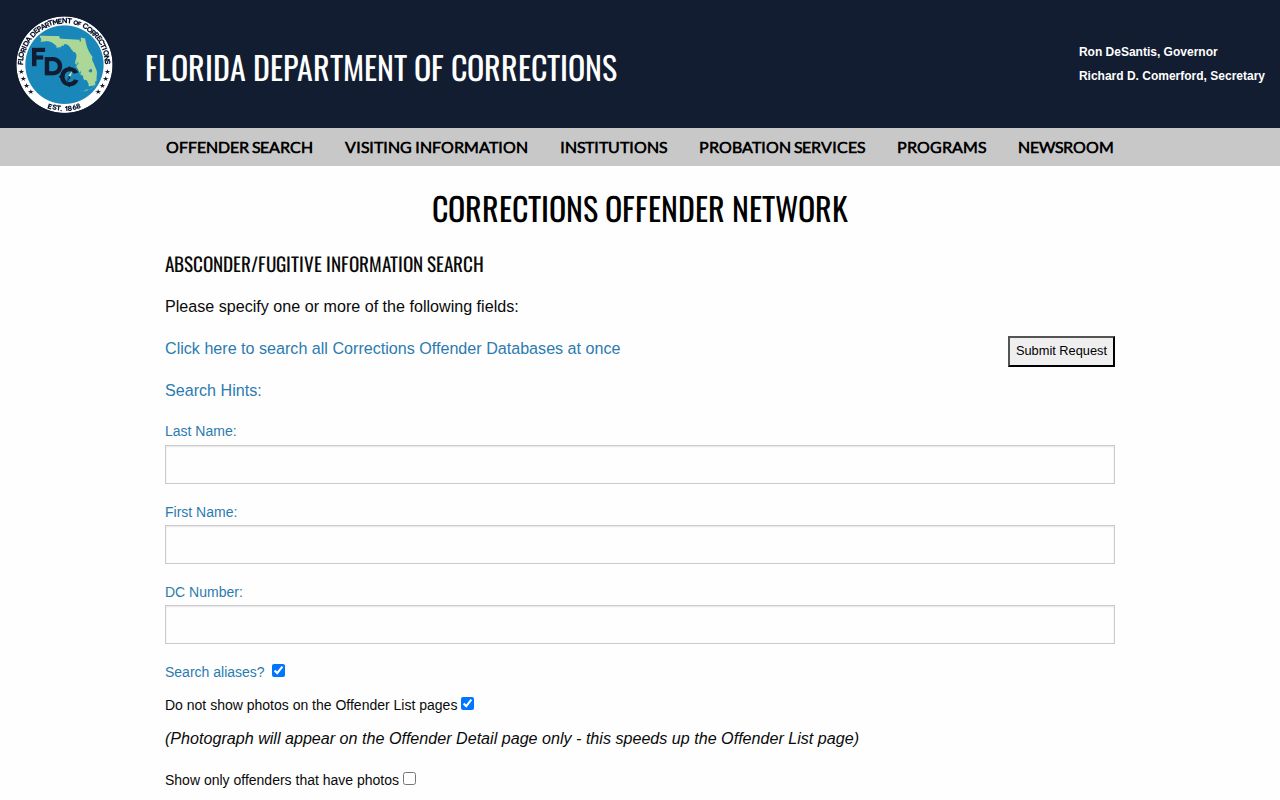
Update practices differ between the two FDC pages. The absconder and fugitive database refreshes on a regular schedule. Termination and location changes update more often. Escape records begin when an escape occurs. They then change when new information arrives or a capture status shifts. FDC's absconder status search is shown below, with status and update details tied to that FDC population.
Neither FDC list works as a county warrant finder. When a person's status looks unclear, rely on the current FDC record and its official tip route. An absconder or escape entry does not prove a separate county charge or a final court outcome.
Florida USMS Districts and Custody
Florida's fugitive work for the U.S. Marshals Service splits across three federal districts: Northern, Middle, and Southern. Each district page lays out its task-force structure and federal coverage. You will also find office details and profiled fugitives there. Treat those profiles as selections, though. They are not a full statewide warrant list. Nor do they cover everyone local police want. One tip line, 1-888-869-4589, serves all three districts. It runs around the clock. The inventory link takes you to each official profile and its current directions.
A federal custody locator answers a different question than a fugitive profile. The Bureau of Prisons covers federal inmates. Its records run from 1982 forward. Search by register number. Or search a name with filters. Results can include the register number, age, race, sex, release date, location, and status. Booking photographs are not part of the record. The BOP inmate locator search fields appear below, with no photo field among them.
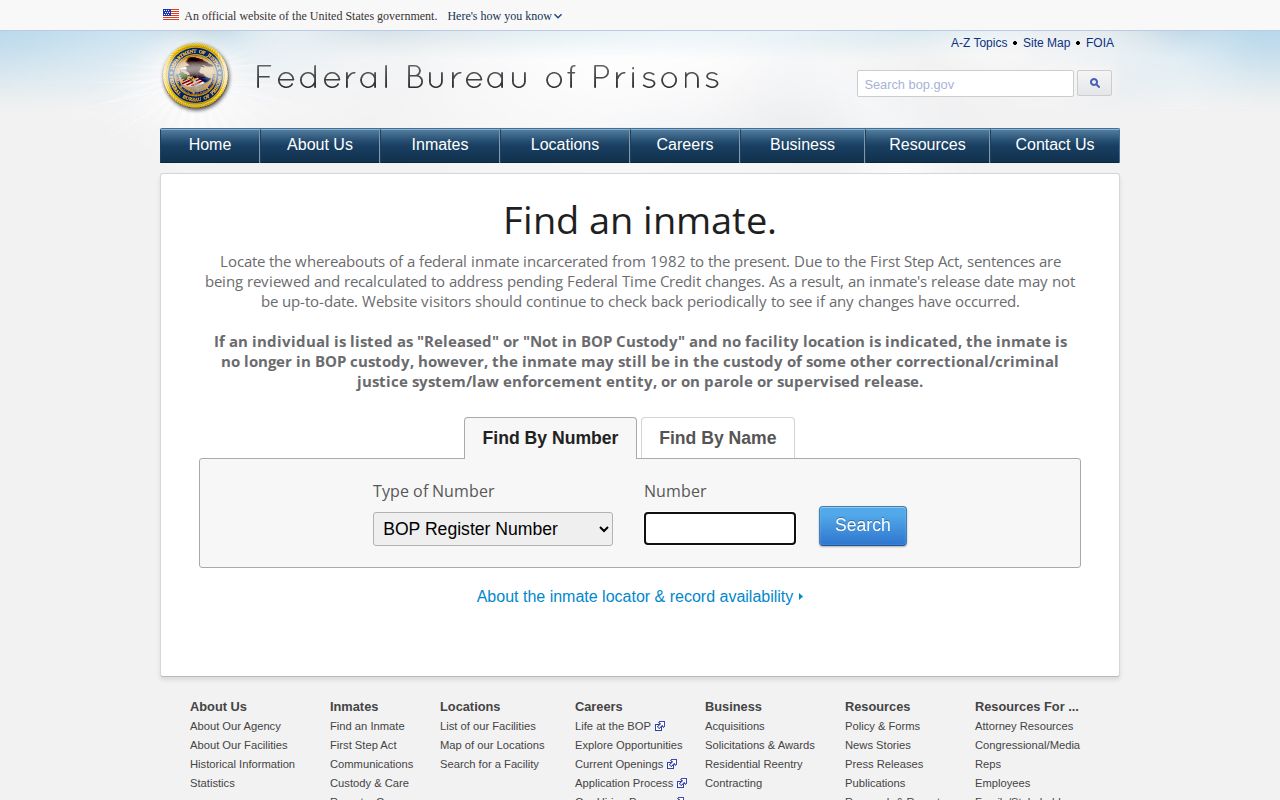
The BOP page covers federal custody only. It skips Florida county jail bookings, state prison absconders, and most outstanding warrants. Someone absent from the locator may simply have been released or transferred. Another agency might hold the person instead. In some cases BOP never had custody at all. For verification, go to the agency holding the case or custody record.
Note: BOP returns location and status fields, not a Florida mugshot source or a complete federal wanted list.