
Florida Busted Mugshots
Every Florida booking photo starts with an arrest. The arresting agency takes the picture during intake at the jail. The paper trail can be detailed. It may list the person's name along with the arresting and booking agencies. Time and place of intake appear too. So does the charge entered at booking and a probable-cause summary. Who holds the record depends on custody. A county sheriff or jail holds it. The Florida Department of Corrections is different. FDC keeps records for people sentenced to state custody or supervision. Its offender photo is not a county booking photo. The two answer different questions, so search the layer that fits the person you want. For the open-records side, the Florida Attorney General's opinion on law-enforcement booking photos sets out the general rule and where exemptions cut it off.
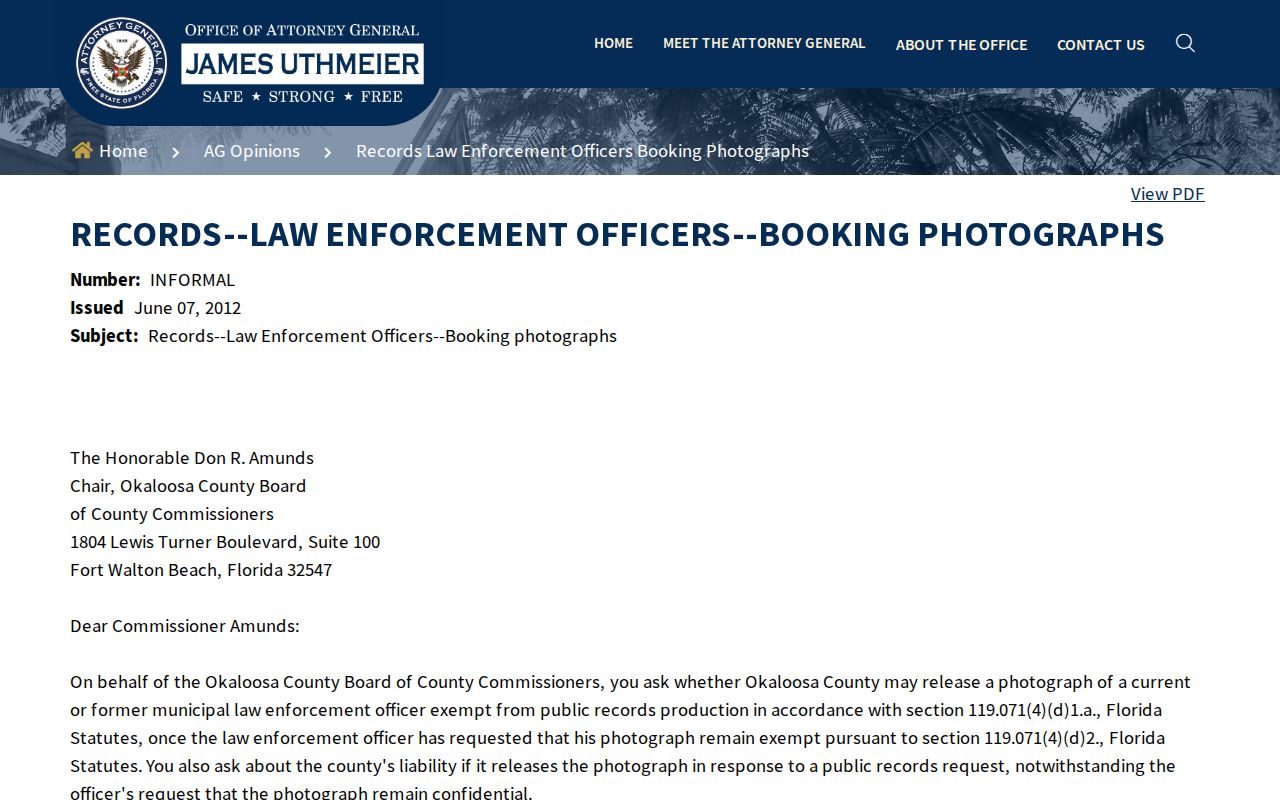
An opinion is guidance, not a mandate. A specific statute or a protected status can still block release of a given image.
Florida Busted Mugshot Law
Florida's public-records law is Chapter 119. It lets the public inspect and copy records held by state and local agencies, subject to exemptions. Section 119.07 adds duties for the custodian. Responses must be prompt and made in good faith. The custodian also has to separate exempt material from what can be released. A booking photo generally counts as an agency record. Confidentiality rules can still apply to parts of a case file. Broad access does not force a web roster to display every photo.
A separate statute, Florida Statutes §901.43, covers commercial publishers of booking photographs. It targets sites that charge for removal. A commercial publication business model falls under it too. The removal path works through registered mail. The person pictured, or a legal representative, writes to the publisher's registered agent and identifies the exact image with sufficient proof of identity. Removal must happen within 10 calendar days, free. Republication after removal is barred. News accounts and private copies sit outside this takedown right. Courts can grant an injunction, and penalties run $1,000 per day for noncompliance and $5,000 per day for later republication. Read §901.43's current text for its scope and remedy rules.
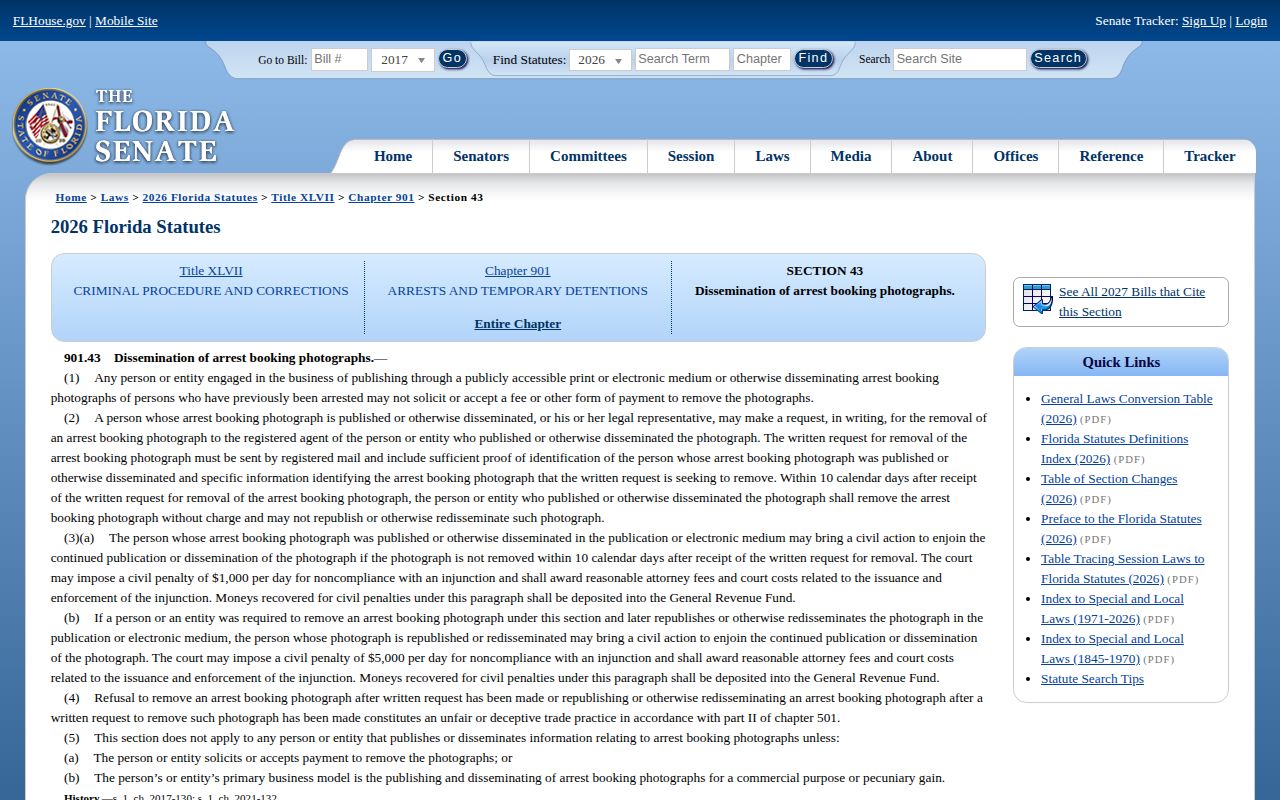
Florida's removal statute covers only certain publishers and certain photographs. The request route works when both the site and the photo fit its coverage rules. Paying a service does not wipe an agency booking record or a court file. Beware of anyone promising to erase every copy, official or private. Save the exact page address and your delivery record. For the full statute, sealing, and private-copy rules, see the Florida mugshot law page, and get legal advice for a live dispute.
Florida Busted Mugshot Law History
The no-fee removal rule began as Senate Bill 118. It took effect July 1, 2018. In 2021, Chapter 2021-132 widened the law to commercial mugshot businesses and banned republication after removal, starting October 1, 2021. The original enactment and its policy history sit on the 2017 Senate bill page.
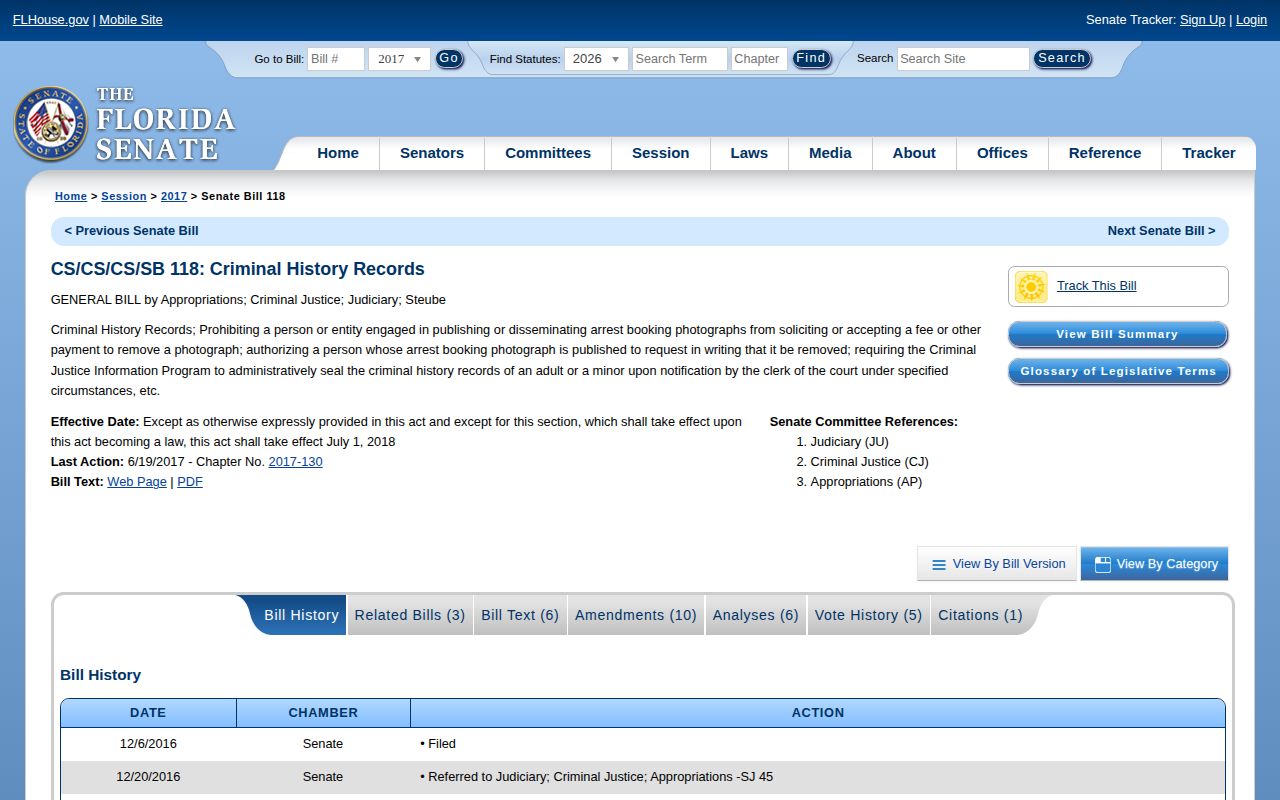
The aim was removal-for-payment schemes, not journalism. News reports and private copies stay untouched by the statute.
Florida Booking Record Fields
Florida has no single statewide booking screen. Each county does things its own way. A sheriff's roster may show nothing more than a name and custody status. A formal record request can reach a fuller intake sheet. The state retention schedule allows fields like the charge, arresting and booking officer, time and place, and a probable-cause summary, and the list below separates common county booking details from the state prison layer.
| Field | What it can show |
|---|---|
| Name and booking number | Identity labels used by the jail record; spelling and identifiers should be checked against the source agency. |
| Booking time and place | When and where intake was recorded, not necessarily the exact time of the alleged event. |
| Agency and intake officers | The law-enforcement office that made the arrest and the arresting or booking officer named in the intake record. |
| Charge and probable-cause summary | The charge entered at booking and a summary tied to the arrest record; neither is a court finding. |
| Custody, bond, release, or court details | These may appear in a county system when that office publishes them. There is no uniform statewide screen or field set. |
| Booking photograph | An image made during local intake, subject to disclosure exemptions and the agency's publication practice. |
| FDC number, status, offense, and photo | The state offender record for a person in an FDC population; it is separate from a county jail intake entry. |
The FDC search works from an offender number. Results can link a name or alias, offense information, status, and location. A photograph appears when one exists. A county record and a state offender profile answer different questions. For the case outcome, the clerk's docket is the source to check.
- Booking
- The intake process that records a person's identity and arrest details after an agency takes the person into custody.
- Arraignment
- A court hearing where the charge is addressed and a plea may be entered.
- Bond
- A court-set amount or condition that may allow release while a case is pending.
- Disposition
- The official outcome recorded in the court docket.
- Expungement
- A court-authorized process that directs agencies to destroy or obliterate a record, subject to state law.
Request a Florida Booking Record
Send the request straight to the agency holding it. That can be a sheriff, a jail, or a city police department. Give a name, county, and approximate booking date. Add the booking number if you have it. Ask for the booking sheet and photo as separate items. Do this whenever a portal lists the arrest but shows no image. Florida law demands a prompt, good-faith answer. Counties differ on channels and processing time. No statewide fee or turnaround promise covers every request. The public-records statute sets the baseline for inspection, response, and redaction.
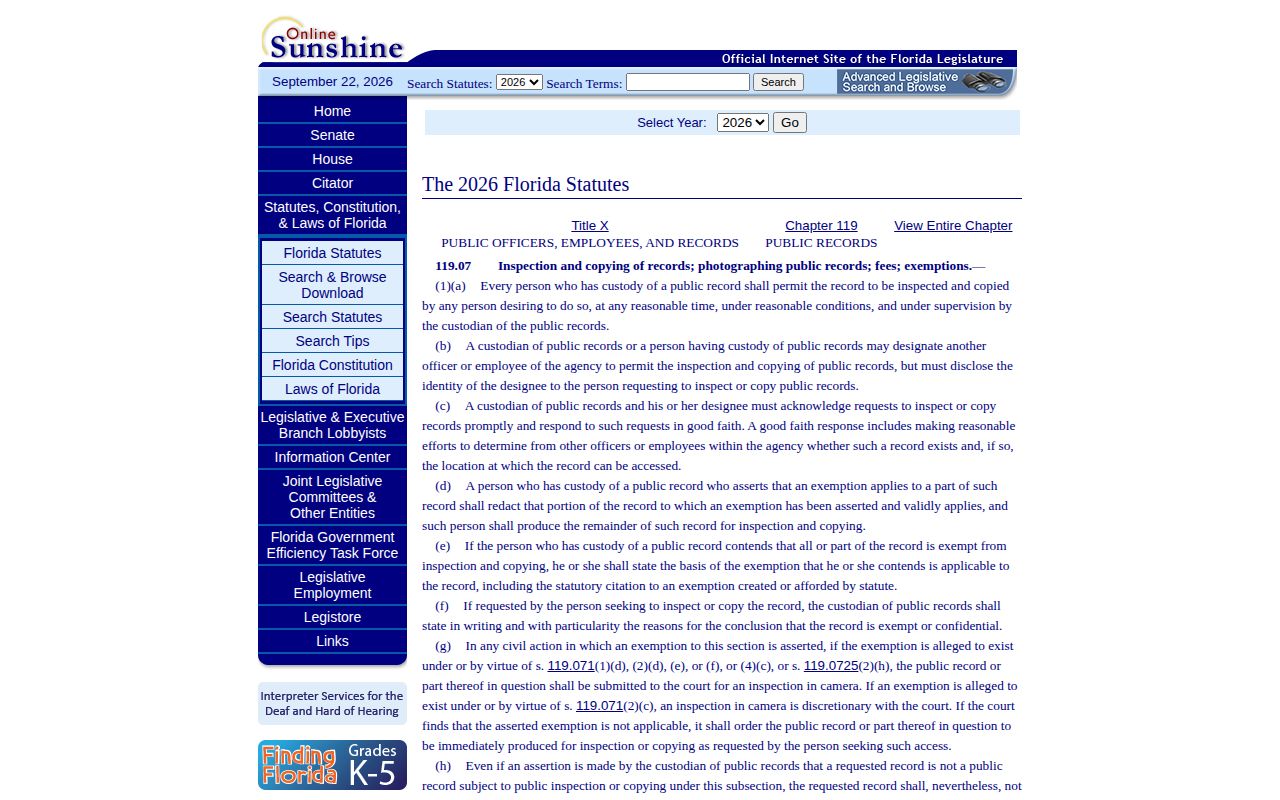
If something is withheld, ask why. Ask the custodian to name the legal basis for each withheld portion and to release whatever the law still allows.
- Identify the county and the agency that booked or arrested the person. Choose the county tied to the arrest.
- Request a specific record, such as the booking photograph and intake sheet for a named person on an approximate date. A defined request is easier to route than a demand for every mugshot statewide.
- Ask for an electronic copy if available, and provide a booking number or case number when known. The agency may redact material covered by an exemption.
- For a state prison or supervision record not shown in the search portal, use the FDC public-records request route. Include the person's name, DC number if known, record type, and date range.
FDC's page promises no free copy or timeline. Each county sets its own process. Keeping your request and the response on hand makes any follow-up easier, since you can point back to the same record.
Florida Juvenile and Sealed Records
Juvenile records sit between open and closed. Some are public, and some are not. Florida's juvenile confidentiality law carves out exceptions. It covers offenses that would be felonies for an adult and cases moved to adult court. Age, offense, and case status matter. Never republish a photo just because a private page shows it.
Sealing and expungement are not the same thing. A sealed record stays closed to the public but open for certain official purposes. An expunged one is destroyed or obliterated. FDLE keeps a confidential copy for uses the law allows. A Certificate of Eligibility is a step, not an order. Eligibility turns on the record itself and on statutory conditions. Check the current FDLE sealing and expungement information before relying on any general summary.
Florida also has a narrow automatic-sealing path under §943.0595. It covers certain non-forcible felony and non-enumerated-offense records. Qualifying cases include those with no charging document. They also cover counts dismissed or nolle prossed within the statute's terms, and acquittals. The clerk reports the disposition to FDLE, which seals its copy and notifies the clerk. Other criminal-justice agencies keep theirs. It is a limited route, not a general promise. Florida's Chapter 943 statutes spell out the conditions and exceptions.
No agency order erases copies on its own. An unrelated publisher, social account, or news site can still hold one. Florida's photo statute may offer a separate request route to a covered publisher. An old copy online says nothing about the official record's status. Ask the original custodian first. That is the practical order. Then work through the publisher's own process if the copy stays up.
Florida Booking Record Retention
Retention rules come from the state, not from websites. The Florida Department of State's General Records Schedule GS2 sets minimum retention periods. It applies to the records it lists. Item 16 covers booking records, from intake material to charge, officer, time, place, and probable-cause details. The minimum is one anniversary year after release. Item 22 covers commitment and release lists, including a 24-hour list, on the same minimum. Item 61 makes jail docket books permanent.
Retention is not the same as online visibility. A sheriff can keep a record that is no longer searchable on the web. A third party can keep a copy after an official page comes down. Agencies may hold records longer than the minimum. So confirm the actual state schedule and local practice when a specific record matters.
For older photos, start with the arresting agency. Then ask about the State Archives of Florida. Florida Memory holds selected corrections and historical news images, a few from well-known cases. It is not a complete county booking-photo archive. A catalog search can name collections, but it cannot promise a county intake photo survived.
The GS2 retention schedule separates minimum retention from online access.
Find Florida Busted Mugshots
Start with the county of the arrest. Home county does not matter. The arresting agency may be a sheriff's office or a city police department, while the booking happens in a county jail. Once you know the spot, follow the official channel. A lookup confirms a record exists, but it is only the first step in the chain.
- Choose the county and open its sheriff or jail roster. Search by name and, when known, booking date or booking number. Check whether the view covers current custody, recent bookings, or released records.
- If there is no photo, open the booking detail or request the image and booking sheet from the agency. Some counties publish record data without a searchable photo.
- For a person sentenced to state prison or listed under state supervision, use the FDC offender search. It does not cover county-jail custody or every other form of supervision.
- Use the county Clerk of Court's criminal-case portal to confirm charges and disposition. Look for the case number from the booking record and read the docket's actual terms.
- If the county has no public roster, contact the arresting agency or county custodian with a narrow records request. Use the federal locator only when the person may be in federal custody.
Does a blank photo mean no arrest? No. A county may keep the booking record but show no image online. It may also limit the roster to current custody. When that happens, a records request to the correct agency is the next official step.
For county sources, use the Florida County Directory. Each local site points to that county's own arrest and jail records instead of a combined statewide feed.
Florida Busted Mugshots by County
Florida runs booking records county by county. All 67 counties do it their own way. Some post photos quickly and offer filters for current and released inmates, while others publish little more than an arrest report or a contact for the records custodian. Vendors operate several portals, so one provider can display different fields in different counties. The sheriff or jail remains the source for accuracy. Even when a third party runs the site, verify current status with the jail.
None of this ranks counties by openness or crime. It is just how local systems differ. Large urban systems such as Broward, Hillsborough, Miami-Dade, Duval, Palm Beach, Orange, Pinellas, and Polk more often run searchable portals with history filters. Smaller counties lean on an app, a short report, a custody list, or a records request. Exceptions cut both ways. Some small counties have full search portals, and some large ones show current inmates only.
Start with the county where the arrest happened. Then check the sheriff or police source named on that county page. City arrests often get booked at the county jail, yet the arresting department may still hold its own incident report. The directory lists Florida counties alphabetically and links each one to its local site.
Florida FDC Offender Search
Florida's prison agency is the Department of Corrections (FDC). FDC runs the Corrections Offender Network, whose official search form accepts a name, a DC number, or an alias. A DC number runs six characters. Six digits, or a letter plus five. A name search can match a prefix and return several people, so compare the record details before opening a profile.
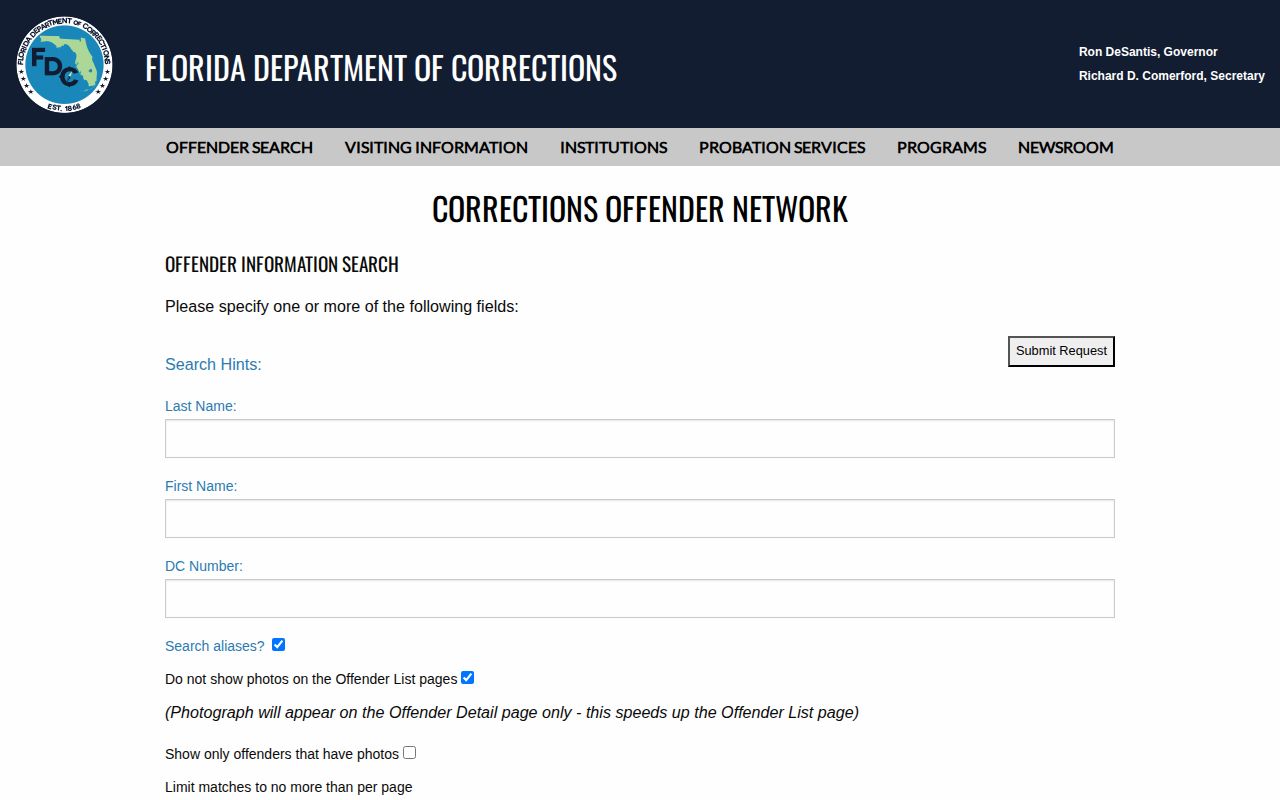
Search controls can hide photos on list pages or limit results to offenders who have them. A photo can still appear on the detail page. An empty image in a list means nothing. The FDC search menu keeps five populations separate. Inmate, supervised, release, escape, and absconder or fugitive searches each open their own view.
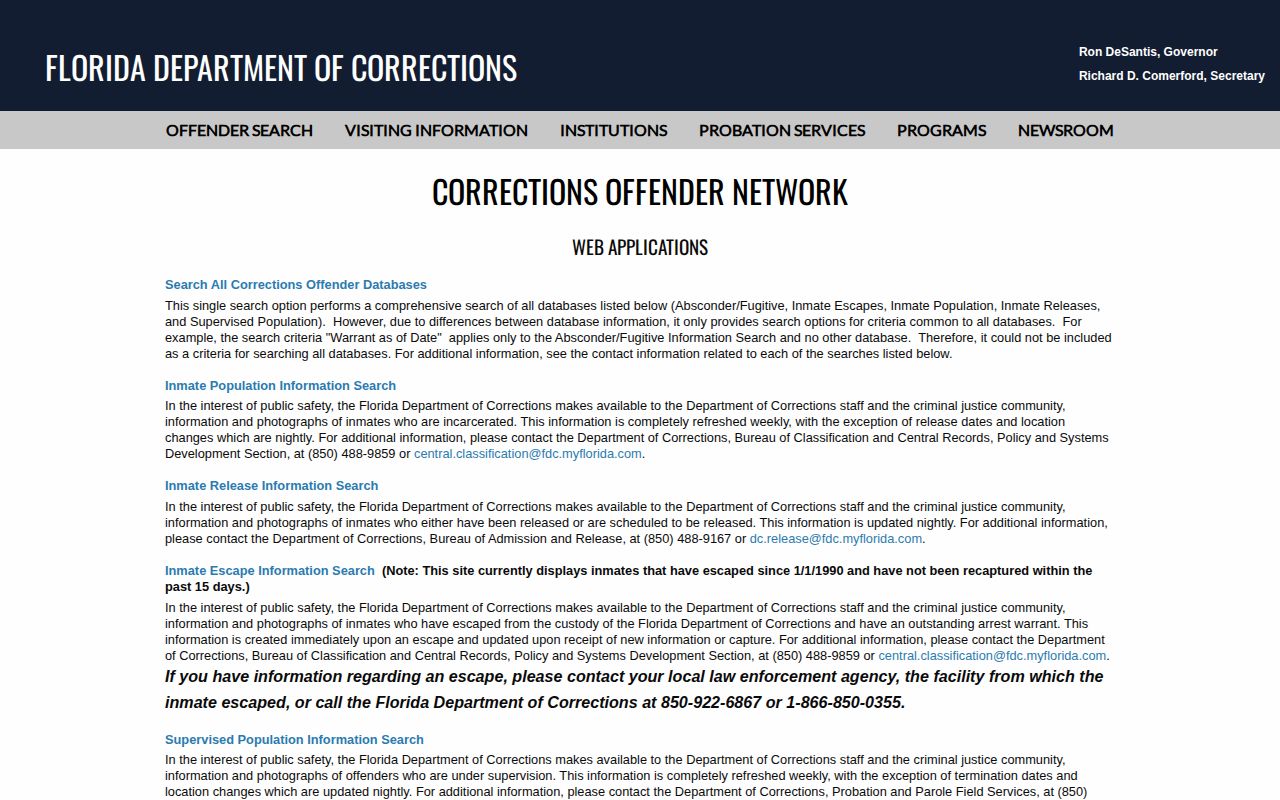
An FDC search covers felony offenders sentenced to the department. County jail bookings are not included. Neither is county probation. A person can show up in a release result after leaving prison, which says nothing about current custody or whether every former offender stays searchable. Population views refresh on their own schedules. Location and release details can lag behind. FDC publishes no set schedule for replacing offender photos, so check the profile's status note or request a record from the department.
Florida Warrant Checks
A warrant is a court order. It authorizes a law-enforcement action. A statewide wanted-person entry is only a lead. Florida's FDLE Public Access System lets anyone search wanted-person records that agencies report. Each record can name the reporting agency and give a route for sending in tips. FDLE itself warns that a listing does not confirm an active warrant.
FDC's absconder and escape searches are separate tools. They answer to the state prison system, not to county warrants or the FDLE wanted list. A supervision absconder status, an escape status, and a court-issued arrest warrant are three different records. To verify a county warrant, contact the clerk or the agency that issued it. If one might apply to you, talk with a lawyer or the court about a safe way to resolve it.
Never approach or follow someone because of a wanted page. For an immediate threat, call emergency services. Otherwise, use the reporting agency's tip route. The wanted search is a check-and-report channel, nothing more. The FDLE Public Access System Wanted Persons search pulls its data from the state criminal information system. Updates run about every 24 hours.
Booked, Released, Sentenced
The photo's source tracks the custody stage. These records do not replace one another. A released person can still have a county booking record, and an FDC profile covers a state population rather than a county one.
| Record stage | Likely source | What it can establish |
|---|---|---|
| Newly booked or in county custody | County sheriff, jail, or arresting agency | Intake entry and, where released by policy, a booking image or custody status. |
| Released from county custody | County booking record, release view, or public-record request | The prior booking record; a roster may no longer show the person. |
| Case filed or resolved | County Clerk of Court | The docket and recorded disposition, which must be read on its own terms. |
| Sentenced to FDC or under FDC supervision | FDC Corrections Offender Network | The department's offender profile, applicable status, and attached photo when available. |
| Federal custody | BOP or ICE locator, depending on the agency | Locator details within that system; BOP's search does not supply a booking image. |
One person can land in several systems over time. Match the record number and case details. Check the page's update note, and open the court file to see where the case actually stands.
Florida Busted Roster and Feed Windows
Florida keeps no single statewide jail roster. Each county runs its own system for arrest and booking records. That means search tools vary widely from place to place. Others buy a vendor portal, publish arrest reports, offer a mobile app, or take public-record requests. Photos appear differently too. Some rosters show a face beside the name, some reveal it only after a detail page opens, and some carry no public image at all. Filters matter as well. A "current," "released," "both," or "booked in the last 24 hours" setting can pull very different records. Date-range search may reach older bookings.
A searchable current-custody photo portal operates in Alachua, Baker, Bay, Bradford, Brevard, Broward, DeSoto, Dixie, Duval, Escambia, Gilchrist, Hamilton, Hernando, Hillsborough, Indian River, Lee, Madison, Manatee, Marion, Miami-Dade, Nassau, Okaloosa, Palm Beach, Pinellas, Polk, Putnam, Santa Rosa, Seminole, Sumter, Suwannee, Taylor, Volusia, Walton, and Washington. A search returns a booking photo. That covers the public endpoint each county opens. It is not a statewide promise that every booking or image appears.
Eleven of those counties add a released, historical, date-range, or recent-booking option: Bradford, Brevard, Broward, Duval, Hillsborough, Lee, Palm Beach, Pinellas, Polk, Seminole, and Volusia. Those options reach past current custody. The time spans differ quite a bit. Hillsborough caps some public web results at 90 days and points older adult inquiries to a separate electronic system, while other counties keep a short current list or use a different release window. A 24-hour report is a snapshot. It is not a full record archive. Another group runs limited or partial feeds: Calhoun, Charlotte, Citrus, Clay, Collier, Flagler, Franklin, Gadsden, Glades, Hardee, Hendry, Highlands, Jackson, Jefferson, Lake, Leon, Levy, Martin, Monroe, Okeechobee, Orange, Osceola, Pasco, Sarasota, St. Johns, St. Lucie, and Wakulla. The public route here may be an app, a brief report, a current-only view, an unclear photo field, an outage, or a records request. Photo behavior varies within this group. Columbia, Gulf, Holmes, Lafayette, Liberty, and Union post no official browser roster with public photos. That says nothing about whether a record exists.
Mobile apps fill the gap in some smaller counties. Jackson and Hardee build their public access around a phone app rather than a browser roster. Wakulla's app advertises an inmate search. Its photo fields and update schedule are another matter. App menus and vendor links change over time, so start from the county sheriff's official landing page before trusting a store listing or an old app result.
Florida Busted Arrest Feed Variations
"Recent arrests" means different things in different counties. It could be a short release report, a current jail list, a booking feed, or a date-filtered search. Citrus, for instance, posts a recent-arrest report rather than a public search for current custody and photos. Baker offers a separate arrest report, possibly a dated PDF snapshot, alongside its search portal. Franklin and some smaller counties lean on arrest logs or a records request. Detail varies across these formats.
Retention differs too. Some portals keep released records for 30 days. Others cap public web results at 90 days for certain Hillsborough listings. Many county pages just show current custody or the latest day. No statewide posting schedule exists. So check the timestamp, the filter label, and the agency note on the county page.
A missing name is not the final word. Try the arresting city police department, or ask the county custodian directly. Some sheriff apps add a custody lookup where the browser roster runs thin. Those apps may need a mobile device, sit with an outside vendor, or return fewer fields than a formal request. An empty app screen proves nothing either way.
Florida Court Dispositions
A booking charge is not the final case result. "Disposition" means the court's recorded outcome, such as a plea, dismissal, acquittal, or judgment. Start with the county and case number. Both come from the booking record. Then search the county Clerk of Court's criminal docket. A current jail page cannot show whether the charge changed or how the case ended.
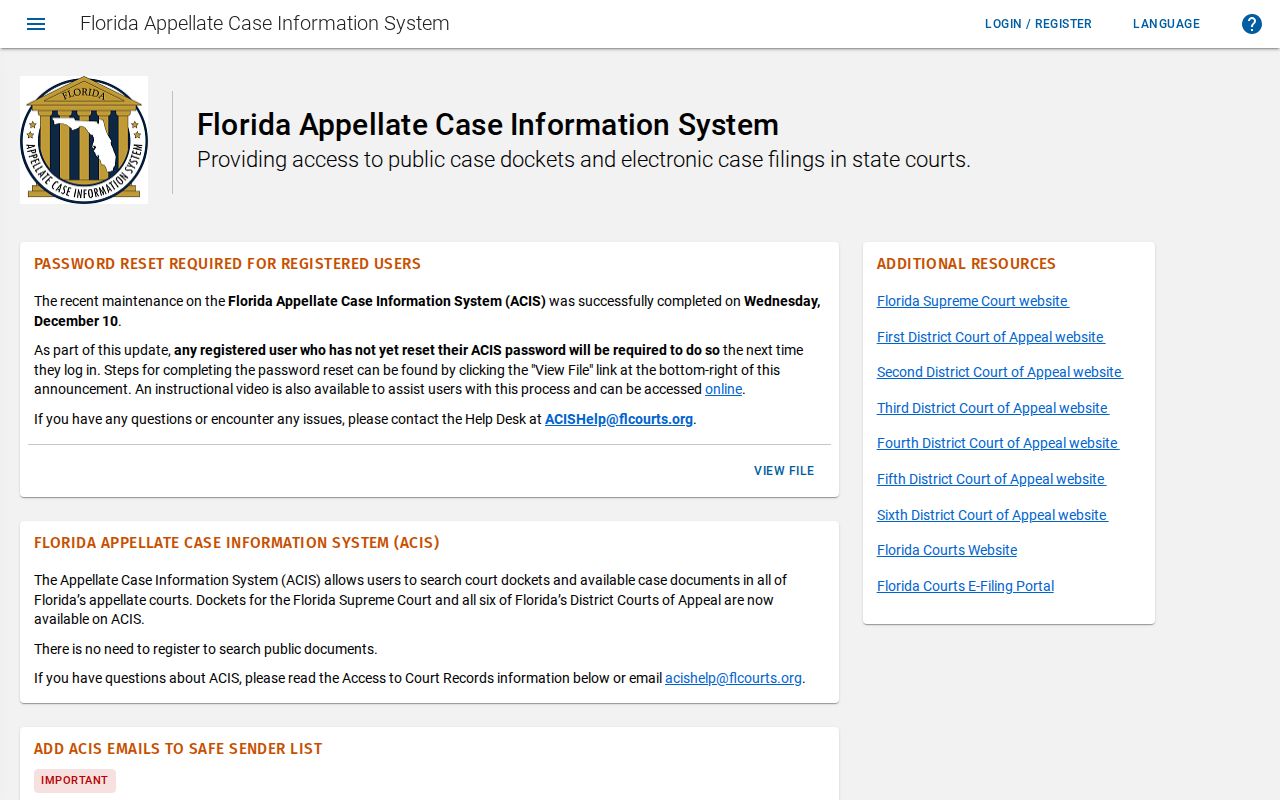
The Florida Courts ACIS public portal covers the Supreme Court and district courts of appeal, not a single public search for every county trial-level criminal case.
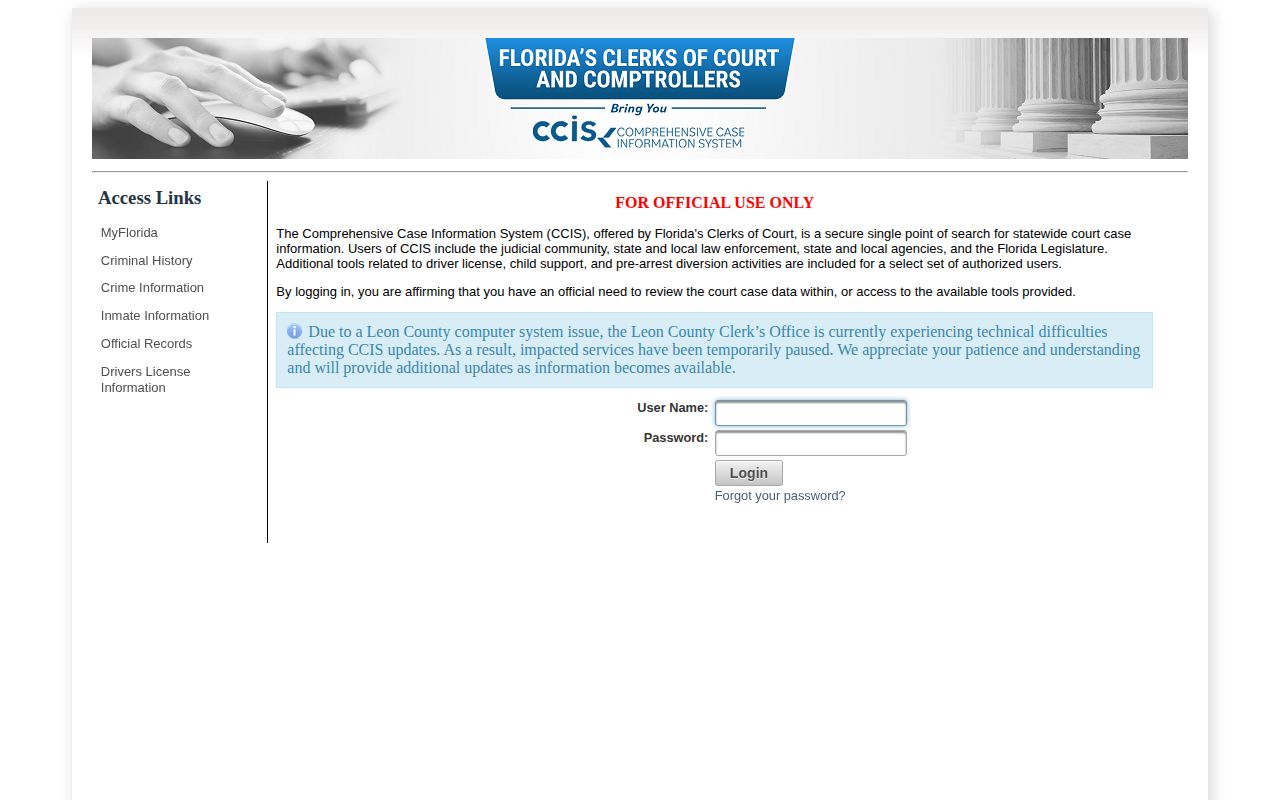
For most arrest cases, the county clerk's site holds the trial docket. The Florida Clerks CCIS system is a secure clerk system. It serves official use, not a public substitute for county criminal case search.
If a public clerk portal cannot search the case, ask the clerk for the docket or case record. Then read the exact docket language. An adjudication withheld is not an acquittal. A dismissal, a no-information decision, and an expungement do not mean the same thing either.
Federal Custody Records
The federal route fits only federal custody. The Bureau of Prisons locator covers federal inmates from 1982 to the present. Search by register number or name, with filters. Results can include name, register number, age, race, sex, release date, location, and status. Booking photos are not included. The BOP inmate locator is a custody tool, not a statewide Florida jail search.
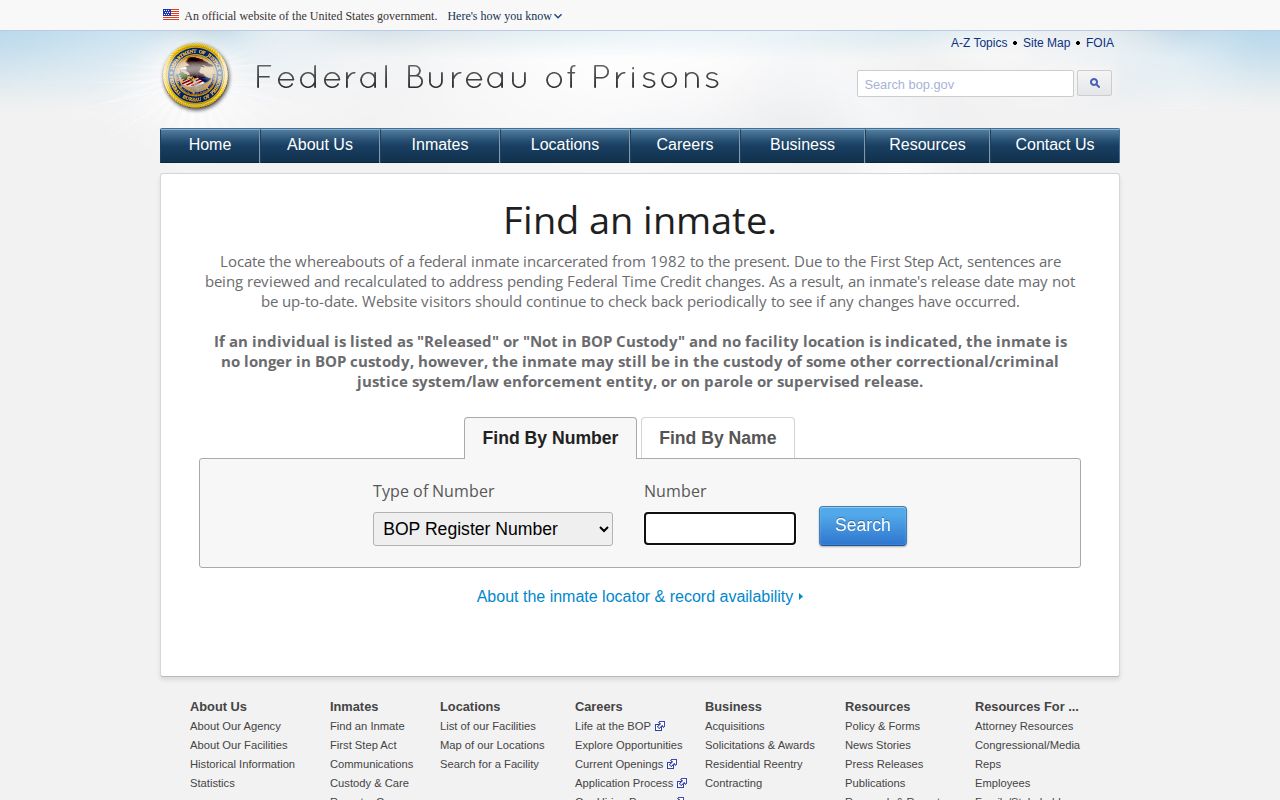
An empty result does not mean someone walked free. Transfers happen. Another agency may hold the person, or BOP custody may never have applied. Immigration detention works differently. ICE keeps its own Online Detainee Locator, built for detainee searches rather than general arrest or mugshot lookups. Searches need an A-number plus country of birth, or a full name with country and date of birth. Treat any locator result as a starting point, never a final answer on the case.
Florida Busted Mugshot Sources
Start with the official record. County agencies, state offices, and court clerks hold the files that matter. Private publishers copy booking data, run news items, or keep old pages alive after an agency redesigns its site. Their versions run late, contain gaps, repeat entries, or simply get details wrong, and a dismissal may never appear there at all. Let a private page point you toward the source. Then confirm every name, date, status, and outcome with the agency or clerk.
| Channel | Official? | How to use it |
|---|---|---|
| County sheriff, jail, or arresting agency | Yes | Primary route for booking entries, photos where released, custody status, and records requests. |
| Florida Department of Corrections | Yes | Search state offender profiles and attached photos; it does not cover county-jail custody. |
| FDLE wanted-person search | Yes | Check a reported wanted-person entry and use the reporting agency route; a listing is not proof of an active warrant. |
| County Clerk of Court and Florida Courts ACIS | Yes | Read the county trial docket for a disposition; ACIS covers appellate and Supreme Court information. |
| BOP or ICE locator | Yes | Check the relevant federal custody system; BOP does not provide booking photos. |
| Busted Newspaper Florida | No | Secondary county copies; the reviewed Florida material did not confirm a clear free removal policy. |
| RecentlyBooked Florida section | No | Private pages described as covering recent arrests; its posted policy offers free correction requests for listed errors or documented changes. |
| Mugshots.com Florida | No | Secondary index with a free record-maintenance policy that distinguishes removal from a favorable-disposition update. |
| Arrests.org Florida | No | Private index with a removal area; the reviewed public material did not show stable eligibility or a guaranteed result. |
| Mugshots.zone Florida county pages | No | County-subdomain copies; a reviewed county contact form asks for the exact page and supporting legal documents. |
Secondary pages also lag behind court outcomes. RecentlyBooked and Mugshots.com each publish a free correction or record-maintenance route. Mugshots.zone describes a free form on its county contact page. Florida Arrests.org devotes a section to removals. It stops short of laying out a stable, fully explained rule. Busted Newspaper's Florida index shows no state-specific free request policy. No private site's terms alter the county file itself. News outlets are a different channel altogether. Local TV stations and papers sometimes attach a booking photo to a story. No statewide feed or shared newsroom standard exists, though. WPTV's photo policy limits booking-photo use and takes free requests for review. BocaNewsNow's policy weighs removal at its own discretion in some case outcomes; nothing is guaranteed. Plenty of other outlets reach the whole state. The list includes WFLA, WESH, WFTV, WKMG/News 6, News4JAX, WPLG/Local 10, WSVN, NBC 6, CBS12, TCPalm, Pensacola News Journal, Northwest Florida Daily News, and the Tallahassee Democrat. Check each publisher's current corrections page. A news article follows no set process. It never works like a commercial mugshot site.